
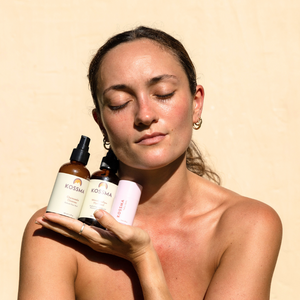
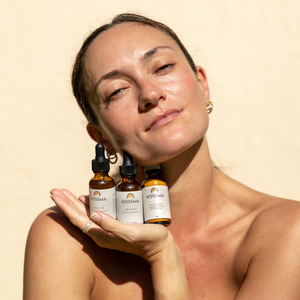
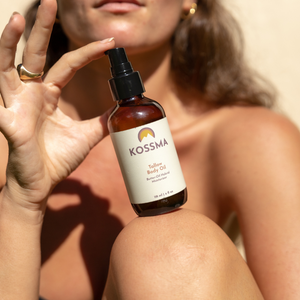
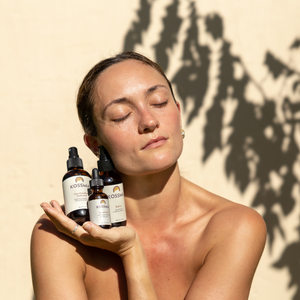
The Kossma approach to skincare is simple. Support the barrier. Reflect its structure. Use ingredients the skin understands and knows how to use. Avoid irritants and unstable PUFA oils that create sensitivity and inflammation. This philosophy creates results that last. As the barrier is nourished it becomes stronger and more resilient, and that resilience is the foundation of beautiful healthy skin. Most natural skincare formulas all look the same, but the skin knows the difference. Our return customer rate is over eighty percent which shows that the Kossma system works. Kossma is natural skincare practiced with intention, clarity and biological intelligence. It is the future of the category and we are committed to leading it.
Bakuchiol
Research on bakuchiol is extremely limited and we do not have long-term safety data for continued or repeated use.
Dhaliwal, S. et al. (2019). A randomized, double-blind study evaluating bakuchiol and retinol. British Journal of Dermatology, 180(2), 289–296. https://www.ncbi.nlm.nih.gov/pmc/articles/PMC7572838/
• Existing clinical data is weak because the largest and most cited study included only 44 participants, which is not enough to establish efficacy or safety.
Dhaliwal, S. et al. (2019). British Journal of Dermatology. https://www.ncbi.nlm.nih.gov/pmc/articles/PMC7572838/
• Bakuchiol results appear slowly and do not compare in potency or speed to true retinoids, which have decades of clinical evidence supporting them.
Chaudhuri, R., & Bojanowski, K. (2014). Bakuchiol: A retinol-like functional compound revealed by gene expression. International Journal of Cosmetic Science, 36(3), 221–230. https://onlinelibrary.wiley.com/doi/10.1111/ics.12145
• Some people experience irritation, redness or allergic reactions when using bakuchiol, despite “gentle” marketing claims.
Chaudhuri, R., & Bojanowski, K. (2014). International Journal of Cosmetic Science. https://onlinelibrary.wiley.com/doi/10.1111/ics.12145
• There is no clear safety information for pregnancy or breastfeeding because bakuchiol has never been tested in these populations.
Goldberg, D. J. (2020). Bakuchiol and retinol: A perspective. Journal of Drugs in Dermatology, 19(5), 523–524. https://jddonline.com/articles/dermatology/S1545961620P0523X
• Product quality varies widely because many “bakuchiol” products use unstandardized plant extracts or bakuchi oil, which behave differently than purified bakuchiol.
Chaudhuri, R., & Bojanowski, K. (2014). International Journal of Cosmetic Science. https://onlinelibrary.wiley.com/doi/10.1111/ics.12145
• Bakuchiol’s rise in skincare comes mostly from marketing momentum, not consistent user results or robust clinical evidence.
Goldberg, D. J. (2020). Journal of Drugs in Dermatology. https://jddonline.com/articles/dermatology/S1545961620P0523X
Hyaluronic Acid
• Low–molecular-weight hyaluronic acid (<50 kDa) activates inflammatory pathways and increases cytokine expression, especially in compromised skin.
Campo, G. et al. (2020). Hyaluronic acid fragments as inflammatory mediators. International Journal of Molecular Sciences. https://www.mdpi.com/1422-0067/21/9/3244
• Fragmented HA can worsen inflammation in already irritated or barrier-damaged skin.
Pillai, S. et al. (2020). Inflammatory responses to fragmented hyaluronic acid. Experimental Dermatology. https://onlinelibrary.wiley.com/doi/10.1111/exd.14122
• In low humidity HA can increase TEWL by drawing moisture out of the skin unless sealed with an occlusive.
Téllez-Malpartida, M. et al. (2017). TEWL behavior of hyaluronic acid in dry environments. Cosmetics, 4(4), 50. https://www.mdpi.com/2079-9284/4/4/50
• HA can cause irritation, redness, stinging, and breakouts in sensitive skin types.
Draelos, Z. D. (2012). Adverse reactions to HA-containing moisturizers. Journal of Cosmetic Dermatology. https://onlinelibrary.wiley.com/doi/10.1111/j.1473-2165.2011.00582.x
• HA provides only superficial hydration because it cannot penetrate deeply without chemical modification, making its effects temporary.
Juhlin, L. (1997). Penetration limits of hyaluronic acid in human skin. Acta Dermato-Venereologica. https://www.medicaljournals.se/acta/content_files/files/pdf/77/3/2230.pdf
Essential Oils
• Essential oils behave like irritants on the skin and can trigger sensitivity rather than support skin health.
Scheinman, P. (2002). Allergic contact dermatitis to essential oils. American Journal of Clinical Dermatology. https://link.springer.com/article/10.2165/00128071-200203020-00005
• Their volatile compounds break down the lipids that hold skin cells together which weakens the barrier.
Johansen, J. D. et al. (2011). Fragrance contact allergy and essential oil sensitization. Contact Dermatitis. https://onlinelibrary.wiley.com/doi/10.1111/j.1600-0536.2011.01957.x
• With repeated use they can push skin into long-term reactivity making redness and irritation more common.
Sköld, M. et al. (2006). Air-oxidized essential oils as potent sensitizers. Contact Dermatitis. https://onlinelibrary.wiley.com/doi/10.1111/j.0105-1873.2006.00844.x
• Many essential oils increase UV sensitivity which raises the risk of pigmentation and sun damage.
Fotiades, J. et al. (2021). Phototoxic reactions from citrus essential oils. Dermatology Reports. https://www.ncbi.nlm.nih.gov/pmc/articles/PMC7953072/
• They don’t provide nutrients or structural support to the skin — they simply add fragrance.
(Supported broadly by dermatology literature noting essential oils are functional fragrances, not barrier lipids.)
• Their antibacterial nature kills the skin’s protective microbiome.
Lin, T. K. et al. (2019). The impact of antimicrobial essential oils on skin microbiota. Microorganisms, 7(10), 359. https://www.mdpi.com/2076-2607/7/10/359
• Oxidation makes essential oils even more irritating especially once a bottle is opened.
Sköld, M. et al. (2006). Oxidation increases sensitization potency of essential oils. Contact Dermatitis. https://onlinelibrary.wiley.com/doi/10.1111/j.0105-1873.2006.00844.x
• Purity is a marketing claim because all essential oils contain compounds harsh enough to harm skin.
Hammer, K. A. et al. (2006). Sensitizing and irritant components within essential oils. Clinical Microbiology Reviews. https://cmr.asm.org/content/19/1/50
• Repeated use can create new allergies that never existed before.
Hosteing, S. et al. (2014). Induction of new allergies from chronic exposure to essential-oil components. Contact Dermatitis. https://onlinelibrary.wiley.com/doi/10.1111/cod.12173
Seed oils
• High-PUFA seed oils oxidize quickly when exposed to air, heat or UV light, producing reactive lipid peroxides and free radicals that irritate skin and promote inflammation.
Alekseev, A. et al. (2025). Oxidative-inflammatory modulation of skin lipid metabolism. Cosmetics, 12(4), 130. https://www.mdpi.com/2079-9284/12/4/130
• When PUFAs oxidize, they destabilize lipid membranes and form water-permeable pores, weakening the skin barrier.
Gurtovenko, A. & Anwar, J. (2017). Alpha-tocopherol inhibits pore formation in oxidized bilayers. PCCP. https://pubs.rsc.org/en/content/articlelanding/2017/cp/c6cp08051k
• Lipid peroxidation — which targets PUFA chains first — produces reactive aldehydes (MDA, 4-HNE) that damage cells, increase membrane permeability, and contribute to inflammatory skin diseases.
Li Pomi, F. et al. (2025). Oxidative stress and skin diseases: The role of lipid peroxidation. Antioxidants, 14(5), 555. https://doi.org/10.3390/antiox14050555
• UV radiation drives ROS that preferentially attack polyunsaturated fatty acids in skin lipids, initiating photo-oxidation and accelerating visible aging.
Hussen, N. et al. (2025). Role of antioxidants in skin aging and the molecular mechanism of ROS. Aspects of Molecular Medicine, 5, 100063. https://doi.org/10.1016/j.amolm.2025.100063
• Under UV exposure, unsaturated cosmetic lipids like oleic and linoleic acid worsen lipid dysregulation and inflammation in skin models, while a saturated, oxidation-resistant lipid (squalane) shows the opposite effect.
Alekseev, A. et al. (2025). Cosmetics, 12(4), 130. https://www.mdpi.com/2079-9284/12/4/130
• Environmental oxidants such as ozone directly oxidize unsaturated skin lipids, deplete vitamin E, and disrupt the structure of the stratum corneum lipid matrix — showing the inherent fragility of PUFA-rich barrier lipids.
Petracca, B. et al. (2021). Effects of ozone on stratum corneum lipid integrity. Chem Phys Lipids, 240, 105121. https://doi.org/10.1016/j.chemphyslip.2021.105121
• Ozone exposure depletes antioxidant defenses and induces lipid peroxidation in human stratum corneum, confirming that the outer skin layer’s PUFA content is a major oxidation target.
JID Study. Ozone-Exposure Depletes Vitamin E and Induces Lipid Peroxidation in Human Stratum Corneum. https://www.sciencedirect.com/science/article/pii/S0022202X15428921
• UV light photo-oxidizes skin surface lipids — especially PUFAs and squalene — generating radical species that damage the epidermis and trigger photoaging.
Journal of Raman Spectroscopy study: Skin surface lipids photo-oxidation. https://analyticalsciencejournals.onlinelibrary.wiley.com/doi/10.1002/jrs.6504
• The extent of UV-induced skin lipid peroxidation depends strongly on lipid composition: the more unsaturated the lipids, the greater the oxidative damage — meaning PUFA-rich environments are structurally more vulnerable.
Oxidative damage of human skin lipids: Dependence on lipid composition. BBA. https://www.sciencedirect.com/science/article/pii/S0005276097000933
• Alterations in the skin’s lipid profile caused by oxidation of unsaturated fats are linked to inflammation, impaired repair, and weakened barrier function.
Töröcsik, D. et al. (2020). The skin epilipidome in stress, aging, and inflammation. Frontiers in Endocrinology. https://www.frontiersin.org/articles/10.3389/fendo.2020.607076/full
• Reviews of topical oils show that unstable or easily oxidized oils can disrupt skin-barrier balance and increase irritation depending on their fatty-acid composition.
Boiten, W. et al. (2021). Skin lipids in health and disease. BBA. https://www.sciencedirect.com/science/article/pii/S0009308421000086
• Photoaging is driven in part by the accumulation of oxidized lipids and ROS-driven damage to PUFA-rich membranes in the epidermis and dermis.
Frontiers in Pharmacology (2022). Autophagy plays an essential role in UV-induced photoaging. https://www.frontiersin.org/articles/10.3389/fphar.2022.864331/full
• Excess omega-6 PUFA in diet correlates with systemic oxidative stress and inflammatory markers, suggesting that high-PUFA exposure (topical or dietary) increases oxidative burden on tissues including skin.
Yamashima, T. et al. (2020). Intake of ω-6 PUFA-rich vegetable oils and risk of lifestyle diseases. Advances in Nutrition. https://doi.org/10.1093/advances/nmaa072
• Fatty-acid imbalance is associated with inflammatory skin disorders, reinforcing that PUFA quantity and oxidation state matter for barrier health.
Kim, M. et al. (2023). Dietary Patterns & Atopic Dermatitis Review. Nutrients. https://www.mdpi.com/2072-6643/15/17/3857
• Dermatology diet reviews link omega-6 heavy intake with inflammatory pathways relevant to skin reactivity.
JAAD Diet in Dermatology Review (2014). https://www.jaad.org/article/S0190-9622(14)01576-X/fulltext